Friday, May 21, 2010

Day 108


Our second day out of Clarence Town dawned still and hot. Pete came up on deck for the sunrise and I gratefully turned the boat over to him, stumbled below to my bunk and fell fast asleep to the rhythmic rumble of the diesel motor. Two hours later I was up again. The sun had turned the cabin into an oven and it was too hot to bear, even after only three hours of sleep the night before.

Unalleviated by sea breeze, the heat of the southern sun beat down with physical force. I felt its weight pinning me to the bench. The dark deck boards became so hot they burned the bottoms of my feet and Pete and I had to dump buckets of sea water over the cockpit in order to stay at the helm.

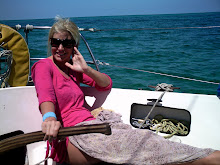
The heat and monotony was broken at eleven thirty when Pete spotted a faint speck broad on our port bow. "Land Ho!" The northeast coast of Cuba now created a tiny break in the straight line horizon. This was as excellent an excuse as any and Pete declared a swim break. We shut down the core, lashed down the tiller, trailed a safety line, and plopped over the rail into the slightly less hot water beside the boat. The sea was a spectacular, mesmerizing blue, crystal clear and incredibly deep. Rays of sun sparkled through the smooth surface, golden beams reaching down and down, fainter and slimmer until they were disappeared completely.

According to the charts, the ocean here was more than 1,400 fathoms deep, more than 8,400 feet, more than a mile and a half of water straight down. It was an eerie feeling knowing there was that much water, that much space beneath me. I swam with my snorkel mask on, glowing white hands and feet flashing briefly on the periphery of my vision, suspended at that intersection of sea and sky, a mile and a half above the earth. As I moved slowly away from the boat, my mind wandered. I wondered what leviathans, what monsters of the deep might be down there, lurking just out of sight in the depths below my toes. I peered fixedly through the water, staring at nothing, watching as the sun beams were swallowed up, and waiting for some smokey form to suddenly solidify out of the dark and come rushing up, mouth gaping, swift and silent.

At this point I pulled my head out of the water. Time to think about something else. I had now swum a fair distance from the boat and looked back. Pete was up on deck coiling a length of rope. The mainsail, which we'd left up, hung limply from the mast. Strolla bobbed softly in the low waves. From my vantage point in the water, the Cuban coastline was no longer in view. Water in every direction. I looked again at the boat and felt a sudden swell of affection for her, our little floating home, the only thing between me and a slow, lonely death. I swam back.

The only swim ladder we have is one Pete salvaged off a wreck on Block Island back in January and it doesn't seem to make climbing aboard any easier so we don't use it. Instead, we head for the chain plates, amidships, kicking up out of the water to grasp the shrouds, hooking a heal over the gunwale, and levering ourselves up and out and on deck from there. It takes a little practice.

Back in the sweltering sun we started up the motor and set off once more for Cuba dousing the deck periodically for the sake of our burning feet. Consulting the charts we realized that we would once again not be able to make port by dark and so decided to spend a second night at sea, turning west heading up the coast.

Tuesday, May 18, 2010

Day 107

Pete and I rowed over to the "E-Z" again this morning to catch the 6:30 weather report. The ocean beyond the little barrier reef that protected our anchorage was dead calm. From the radio we learned that it would remain so. Winds for the coming week were expected to be light, variable, and out of the west.

The last time we'd experienced winds like this was leaving Florida nearly a month before. Two days later, the easterly Trade Winds that prevail in these latitudes had kicked up again, ground our progress to a halt and forced us to divert south to Andros Island. Now that we were making our round-about way back to the states, we'd counted on those east winds to fling us along effortlessly. Apparently, fair winds and calm seas is asking a bit much. After our last few days of sailing, I'm happy with just the calm seas.

With the weather broadcast finished, we helped Lance take in his secondary anchor, made our goodbyes and paddled off to our Strolla to make ready. Three nights and two days of swinging around with the tides and our anchor chain was a tangled web in the rocks. We could see it clearly through the blue-green water, zigzagging back and forth crazily beneath the boat. With a sigh, I took up position on the foredeck. Pete hopped back to the tiller and, with a touch of forward throttle, began to weave the boat around the anchorage as I shouted directions and pulled in the slack chain. Despite our best efforts, we couldn't fully untangle ourselves until after Pete had snapped on his fins and mask and dropped overboard for a little underwater work. Anchors up and we slipped through the harbor entrance a few minutes ahead of Lance's trimaran.


The light west winds were good enough for a casual cruise south to the cape. We were trolling a fishing lure absentmindedly, the pole wedged against our propane tank. This was not the first time we'd tossed a lure out. There had been a few minor misadventures previously that had now left us low on lures and line. I won't recount the details of those events here. Its too painful but, suffice it to say that our inability to catch fish was not the fault of the fish.


Today's fishing episode began like all the others, with the rattle of the fishing pole and the whir of line running off the reel. I let out a yelp to Pete, released the tiller, and lunged for the pole, reaching it just before the line ran out. As I struggled to reel in the monster, Pete struggled to get the boat back on course and the sails reset. When all as back in order, I proudly hoisted my prize onto the deck. Neither of us knew what it was but it was a fish, the largest I'd ever caught, and we were going to eat it. Pete filleted it. I baked it in olive oil with salt and pepper and a side or canned beans and brown rice. It was the perfect size for a meal for two and we were both stuffed.


After sunset the wind died down and we began motoring. The next safe port was Duncan Town in the Ragged Islands. With the light winds we'd had all day, we wouldn't arrive until after midnight. Rather than risk the shallow approach channel in the dark, we decided to press on for Cuba through the dark. Although the wind picked up again after dusk, it remained light and unreliable and we were forced to motor intermittently all night.

By two in the morning we were passing Duncan Town, fifteen miles to the west, a faint yellow glow on the blacked out horizon. That was the only thing we saw all night. The star gazing was incredible.

Thursday, April 29, 2010

Day 105-106


We've spent the last two days in Clarence Town, waiting for the sea to calm down, exploring the town, snorkeling, and hanging out with Lance, the old sailing and fishing charter captain anchored next to us.


Our first morning in the harbor we were down in the dinghy, taking turns yanking on the pull cord of the Seagull until our arms ached. Once again the row ashore would be long and against the wind and we wanted to avoid it if possible.

We were taking a breather when Lance putted over in his motor skiff to ask if we'd like a ride in with him. "Yes please."


Lance had errands to run and Pete and I spent our morning ashore wandering around town. It didn't take long. We visited the community center, toured both the town's churches and the bar, combed the streets and the beach. In our travels we were followed everywhere by "Happy", a little dog that was so certain we would feed him he even waited patiently on the front stoop while we went inside the buildings.


Back in the anchorage with Lance, we were invited aboard his trimaran charter boat "E-Z" for a beer. Lance kept them coming and we kept knocking them down for the next three hours. We lounged in the shady, cushioned comfort of his sheltered cockpit sipping ice cold Heinekens (he had a refrigerator) and listening to the Sunday afternoon programing on NPR (he had satellite radio) and wondering the whole time why we hadn't thought to install these amenities on our boat.

Lance shared some great stories garnered over a lifetime of sailing and fishing among the islands of the West Indies and a tour of duty in Vietnam which he apparently spent working as a lifeguard and ski boat driver at the officer's beach on Cameroon Bay. It was a thoroughly enjoyable afternoon and as the sunbeams turned to early evening gold, we made our way unsteadily into the dingy and puttered back to Strolla for some snorkeling. The highlight was when Pete chased off a four foot Barracuda hiding under our keel.


The next morning I rowed over to listen to the weather report with Lance on his Single Sideband Radio, another item to add to the Strolla wish-list. Lance had offered to let us tinker with our little outboard on the spacious deck of one of his pontoons. He said it would be a much easier, more stable platform. I agreed and spent the morning listening to classic rock and trying unsuccessfully to breathe life back into our little British outboard.

The afternoon was spent back in town. Lance went in to do laundry and Pete and I went along to get online. Brown rice with canned corn again for dinner.

Tuesday, April 27, 2010

Day 104


I was moving a little slow this morning. Consequently, we didn't get out of Calabash Bay until around 8:30. The wind was still holding strong out of the east as we set out. We tacked our way around the tip of the cape and then began our trip south, down the windward side of Long Island to Clarence Town, the first safe harbor we'd come to.

Right from the beginning, as soon as we had nosed out from behind the protection of the cape, we were bashed by the wind whipped swells of the open ocean and I began to feel queasy. I think the gastronomical fragility I was experiencing may have been tied in some way to the hangover I was also nursing this morning.

Thinking back over the trip, I realized every time I've been touched by seasickness, has been on the day immediately following a night of heavy drinking. Obviously there is a correlation, but could this also be the cause? Of course, extensive field testing will be required to be sure.

Today, as expected, was another full day of heavy weather sailing. Staying well off the lee shore to our west, we thrashed along in the sun and the spray and the salt, soon regaining the sand-papery skin and crusty clothes of yesterday.

The amount of extra energy expended during rough weather compared to moderate weather is impressive. The mere act of keeping your balance for the day on a wildly rolling boat is an isometric workout that lasts for ten hours. So, I felt a certain amount of relief when we finally saw the church steeples of Clarence Town pop above the horizon and slowly swell into view.

I would argue that the final couple of hours making our way into Clarence Town harbor were the roughest of the trip thus far. The waves were the biggest we've seen and worse, were steep enough that the crests were breaking and cascading down on us in vertical white walls. At times I even found it necessary to veer off course in order to attack the rolling giants at a more favorable angle.

Fortunately, we arrived in Clarence Town without mishap, dropped anchor, and made a big dinner. We are still comfortably provisioned from our shopping spree at Costco back in Ft. Lauderdale, but the selection is now wearing a bit thin. With no refrigeration, nothing perishable could last this long and with so much food already on board, neither of us can justify buying more so, we eat our pasta and rice and canned corn and dream of the day we'll once again have dairy and red meat.

Day 103

From Indian Hole Point north to Cape Santa Maria was one of those perfect sails. Strong wind, small seas, sunny skies. We didn't even have to shake out the double reef that we'd left in from yesterday. It was a half-day trip, only about thirty miles, and we slid along in fine fashion, smooth and fast.

Once we'd rounded the point and turned north from Indian Hole, once all sails set and trimmed, there wasn't much to do besides sit back and enjoy. But, Pete and I did get a little exercise right at the end, beating our way up into Calabash Bay through a break in the reef that forms its western barrier. Just five tacks is all it took, but that was enough work with the sheets to leave me sore and out of breath. [At this point I should probably clarify that the sheets to which I refer are the ropes that control the sails, as in "port jib sheet" or "main sheet", not "bed sheet"] During the long period of idleness on San Salvador and again in Georgetown the carefully cultivated calluses on my palms had softened and begun to peel off. Now, my hands were throbbing.

We set anchor a safe distance offshore and, it being mid-afternoon, decided to head off for some exploring. Our little Seagull had refused to start the last time we'd tried in Georgetown and neither of us wanted to waste daylight working on it now. Rowing against the wind the quarter mile to the beach didn't sound very pleasant either. So, we pulled on our snorkeling fins, flopped over the side, and swam for it. Fifteen minutes later we were still swimming. Another five after that and we'd dragged ourselves up onto the sand, shucked our fins, and set out.

We headed first for a nearby estuary. The tide was out and great, white sand flats lay empty and exposed for our inspection. The surfaces of these flats were dimpled with small, steep depressions which had remained full of water as the tide receded. Scattered throughout these isolated pockets, hundreds of jellyfish of all colors and sizes clung desperately to life until the changing of the tides would set them free again.

The sand flats sloped imperceptibly downwards to the deep channel. Here, the water puddles grew larger and began to merge together until the water to sand surface ratio was reversed. All was water with only the isolated tops of the small, steep hills poking above like little islands.

It was an interesting phenomenon of these tidal flats that while some of the little islands were hard packed sand that would support our weight with barely a divot, others were soft and waterlogged and allowed us to sink down to our ankles or more.

Now, Pete and I discovered a new game; racing each other at full speed across the flats, leaping from island to island. It was a game of chance as much as skill. We each never knew when we would land on a soft island and be instantly dumped on our faces. Competition was fierce. Crashes were spectacular.

We went on to explore some coral caves, found a buoy and, still covered in sand from our foot races, wandered our way into the swank Club Santa Maria to check the weather forecast. Later, when wading out into the deeper water to begin our swim home, a man came motoring up to us in his dinghy. His name was Frank. He's seen us swim ashore the first time and thought that this time we might like a ride back to our boat. We gratefully accepted.

It was Happy Hour at the club's bar Frank informed us and the Pina Coladas were the best he'd ever had in his life. That was enough for us. We dashed back aboard Strolla, pulled on some shirts and, still barefoot, hopped back in the dinghy with Frank to zoom off to the bar. The Pina Coladas were just as delicious promised.

Monday, April 19, 2010

Day 102

It was a hard, wet trip across from Georgetown to Long Island but, it felt good to be off again, tearing along, bashing through the waves and bending the wind to our will. I have noticed lately that during these rougher weather passages, the old thrill is now tempered by annoying practical concerns. I've begun to worry more about the unnecessary strain we're putting on the hull and rigging. I've also grown weary of the putting life back in order after our home is dumped on its side and shaken violently for a day. This waning enthusiasm for the rigors of ship life are just another little indicator that the trip is nearing its natural end... and that we should shorten sail and next time wait for a better weather window.

Once we'd passed Indian Hole Point we approached a couple of sailboats anchored out in the bay a good half mile from shore. This was far enough out that the east wind had room to whip up some fairly respectable whitecaps between us and the beach. This in turn would make for light and interrupted sleep on our rolling, little boat. It was agreed to continue forward in search of more comfortable sleeping conditions.

The white sand bottom of the bay was clearly visible and none too far beneath us as we held our breath and crept forward. The waves were getting smaller. Finer and finer detail of the ocean floor was coming into focus. When at a point where the waves were low enough to permit easy sleep, I called a halt. We began coasting to a stop as Pete prepared to drop anchor. I wondered aloud why those other boats had stayed so far out in the rougher water. Then, we ran aground.

It was a nice light tap, a gentle warning in soft sand. The bottom shoaled so gradually here that we were still moving forward, digging a shallow groove in the sand with our keel. I threw the tiller hard over. We made a slow u-turn and headed back for deeper water, scraping along the whole way. Ten minutes later we took up our place back among the other boats.

When the anchor was set and the ropes coiled down, it was time for a dive overboard in what has become a ritual and almost requisite swim. Its not just to check that the anchor is properly set, which we do, its an essential step towards proper hygiene in these sweaty latitudes. The last time Pete's skin saw a shower was in Nassau a full two weeks earlier. I'd managed a shower on San Salvador only a week before and so, by boat standards, was actually quite clean. I didn't really even need swim. The sun, however, was still beating down and the heat required some relief. Also, it had been a rough sail and I was feeling a bit salty.

A Note on Ocean Spray: Sailing on any point closer than ninety degrees to the wind results in regular collisions with the oncoming waves. It also means that the splash from these collisions is carried back on the wind the length of the boat, soaking everything. In the relentless tropical heat, the water quickly evaporates. The sea salt in that water does not. It stays and accumulates as each new soaking of spray adds to it.

Today was fairly typical. After being doused in spray every few seconds for the last ten hours, enough salt had been deposited to be visibly white and granulated. The decks felt sandy beneath my bare feet. My shirt and shorts were stiff enough to be bent into shapes. Worst of all was my face. Its creases were caked with a gritty white paste made of salt and sunscreen.

This evening, I dove in after Pete, fully clothed, for a vigorous rub down.

Day 96-101


With our friends from home gone and the boat once more to ourselves, Pete and I spent five more days in Georgetown. Officially we were waiting for the weather to change but really we were just enjoying being sedentary for a while.


We relocated across the harbor from Kidd Cove to the lee side of Stocking Island, the northern barrier of the harbor. Here were the majority of the expatriate cruising community in Georgetown. Many had not moved anchorages in several months or more. Most were retired couples. A few were younger families with children. All spent their days on the beach, in the shade of its coconut trees, playing dominoes, reading, drinking, feeding the manta rays that congregated in the shallows with conch scraps. Volleyball began promptly at 2.


Pete and I carved ourselves out an anchorage among close neighbors and the days quickly began to slide by. We explored the island with its many hills and trails, wandered over its exposed northern beaches and coves, and joined in on some surprisingly competitive beach volleyball with our retiree fellow boaters.

We slept soundly and got up late, ate big meals, read, swam, and made only nominal attempts at productivity. Out on the ocean the headwinds howled but here the waters were calm and the breeze was light. It was a lazy, listless life.


After having been more than three months underway, Pete and I were tired and homesick. The Virgin Islands, where we'd planned to leave the boat for the summer, appeared increasingly out of reach. Time for a new plan. Instead of continuing southeast through the islands we would complete a circle southwest and back up to Florida. The prevailing east winds would make for excellent sailing south along Long Island over to the Ragged Islands in the Jumentos and then across to Cuba. From there we could run east along Cuba's north coast with the wind and the current and then turn north up to Florida and back to Ft. Lauderdale.


Rested and finally bored with Stocking Island, we were ready to be off again. The wind was predicted to swing northeast just enough to permit us to reach over to Indian Hole on Long Island on a port tack. Wednesday night we made our goodbyes and stowed our gear in preparation for an early departure Thursday.